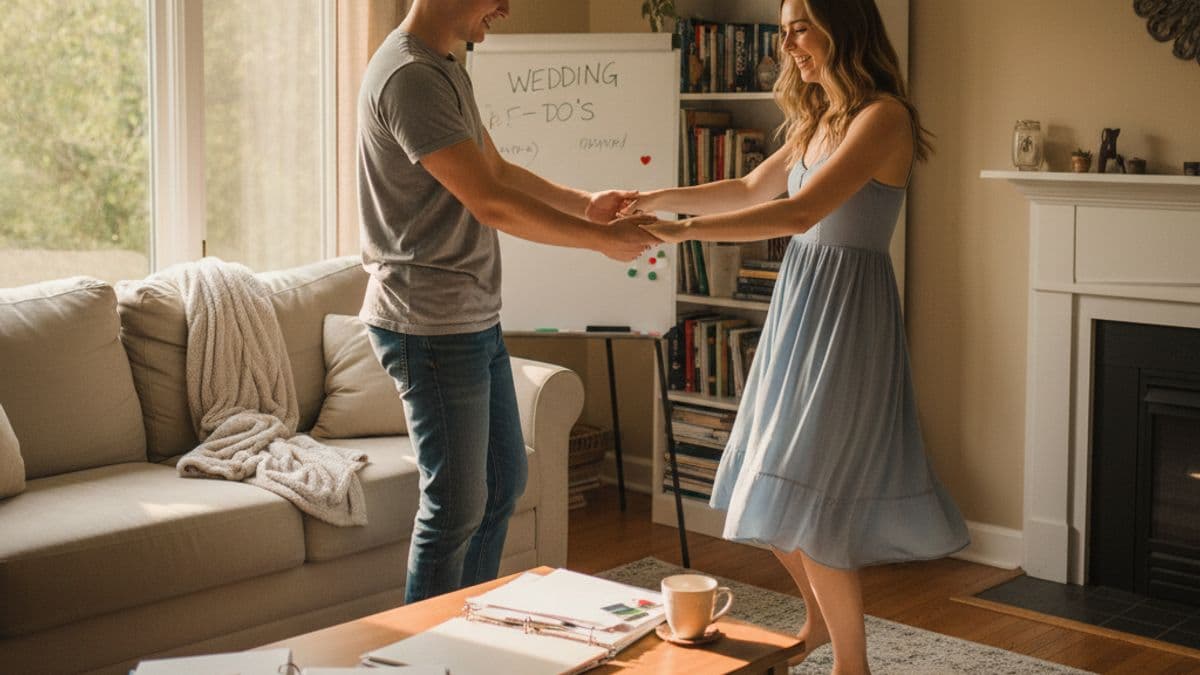
You Do Not Need a Professional Choreographer
Dance lessons are a wonderful option if they fit your budget and schedule. But plenty of couples create beautiful, memorable first dances without ever stepping foot in a studio. The secret is not being a great dancer — it is being prepared. A few hours of practice at home, some basic moves, and a plan for the structure of your dance is all you need to look polished and feel confident.
This guide will walk you through the entire process, from choosing your song structure to learning simple moves that look great on camera.
Step 1: Map the Song
Before you think about footwork, listen to your song five times with fresh ears and identify its structure:
- Intro — How long is the instrumental opening? This is when you walk to the center of the floor and get into position.
- Verse 1 — The quieter, more intimate section. This is where simple swaying works perfectly.
- Chorus — The emotional peak. This is where you can add a spin, a dip, or a more confident move.
- Verse 2 / Bridge — A second opportunity for variation. Change direction, try a new hold, or add subtle footwork.
- Final chorus / Outro — Build to your biggest move here. End with a dip, a kiss, or a moment that gives guests a visual exclamation point.
Write down timestamps for each section. This becomes your roadmap.
Step 2: Master the Basic Hold
Every slow dance starts with the hold. Get comfortable with this:
- Traditional hold — One partner's right hand on the other's waist or mid-back. The other partner's left hand on the shoulder. Free hands clasped together at about chest height, slightly to the side.
- Close hold — Both arms wrapped around each other, foreheads close or touching. More intimate, less formal. This works well for the quieter sections of the song.
- Open hold — Standing slightly apart, connected by one or both hands. This gives you room for spins and turns.
Practice switching between these three holds. Each creates a different visual and emotional effect, and transitioning between them adds variety without requiring fancy footwork.
Step 3: Learn Five Essential Moves
You only need a handful of moves to create a first dance that looks intentional and polished:
- The basic sway — Shift your weight gently from side to side in time with the music. This is your foundation. When in doubt, sway.
- The slow turn — While swaying, gradually rotate as a couple. Over 30 seconds, you will face a different part of the room, which keeps the visual interesting for guests on all sides.
- The single spin — The lead raises one hand and guides the partner through a gentle spin. Practice this slowly until it feels natural. The key is a loose hand connection — do not grip.
- The dip — The lead supports the partner's back with one arm while the partner leans back slightly. You do not need a dramatic movie dip — even a subtle lean looks great in photos. Practice this on a soft surface first and communicate clearly.
- The walk-around — While in an open hold, walk in a small circle around each other. This adds movement and looks graceful without any dance training.
Step 4: Build Your Choreography
Now combine your song map with your moves:
- Intro (walking to the floor) — Walk confidently to the center. Make eye contact with each other, not the crowd. Get into your basic hold as the vocals begin.
- Verse 1 — Basic sway with slow turn. Stay in traditional or close hold. Keep it simple and intimate.
- First chorus — Add a spin. Move to open hold, execute the spin, return to close hold. The shift in energy matches the chorus.
- Verse 2 — Walk-around or continue swaying with a different hold. If the song has a quieter second verse, match it with softer movement.
- Bridge or final chorus — Your biggest moment. Add a second spin, change direction, or incorporate the dip. Build to a visual climax.
- End — Finish with a dip, a kiss, or simply holding each other close as the music fades. A clear ending is better than an awkward trail-off.
Step 5: Practice With Purpose
How you practice matters as much as how often:
- Start without music — Walk through each move slowly, talking through what comes next. Build muscle memory before adding the song.
- Add the music gradually — Play the song and practice each section individually. Do not try to run the full dance until each section feels comfortable.
- Practice in your shoes — If either of you will be wearing heels or new shoes, practice in them at least twice. Your balance and movement change with different footwear.
- Film yourselves — Use your phone to record a run-through. Watching it back reveals things that feel fine but look awkward, like hunched shoulders or stiff arms.
- Practice three to five times total — Enough to feel confident, not so much that it feels rehearsed. You want natural, not robotic.
- Do one practice in similar clothing — If the bride will be in a long dress, practice with a long skirt to get used to the fabric during turns.
Common Mistakes to Avoid
- Overthinking it — Guests are watching two people in love, not judging your technique. Smile, make eye contact, and enjoy the moment.
- Too many moves — Five moves is plenty. Trying to pack in ten different elements makes the dance feel frantic rather than elegant. For more pitfalls to watch for, see our article on first dance mistakes every couple should avoid.
- Forgetting to breathe — Nerves can make you hold your breath, which makes your body tense. Consciously relax your shoulders and breathe.
- Staring at your feet — If you need to glance down occasionally, that is fine. But your default should be looking at your partner's face.
- Not planning the beginning and end — The walk to the dance floor and the final moment are what guests remember most. Plan those deliberately.
What If You Have Two Left Feet?
Genuinely. It does not matter. If the idea of a slow dance is the problem, consider an upbeat first dance song that lets you have fun instead. The most viral wedding dances are not technically impressive — they are emotionally genuine. A couple that laughs through a clumsy spin is more endearing than a couple that executes a perfect routine with no eye contact. Give yourself permission to be imperfect. Your guests will love it.
The Finishing Touch: The Right Song
All the choreography in the world cannot save a first dance set to the wrong song. If you are still choosing, our first dance song guide can help. And if you want your dance to be set to a song that is entirely your own — with lyrics about your relationship and a tempo that works for your comfort level — consider a custom first dance song. A personalized song means every beat was written with your dance in mind, making the choreography feel even more natural.


