Why Write Your Own Vows?
Traditional vows are beautiful, but they are the same for every couple. When you write your own, you are telling your partner — and everyone watching — exactly why you chose this person and what you promise to be for them. Personal vows transform the ceremony from a ritual into a conversation. They make guests laugh, cry, and feel like they are witnessing something real.
The idea of writing your own vows can be intimidating. You are not a professional writer, the stakes feel impossibly high, and the blank page stares back at you. But here is the truth: the best vows are not literary masterpieces. They are honest words from someone who loves deeply and is willing to say so out loud.
Start With the Raw Material
Before you try to write polished sentences, gather your thoughts. Sit down with a notebook and answer these questions without editing yourself:
- When did you first know you loved them?
- What is your favorite ordinary moment together? Not a vacation or a milestone — an everyday moment that made you think, "This is the person I want."
- What has your partner taught you or helped you become?
- What do you promise to do or be for them going forward?
- What is something about your partner that nobody else fully appreciates but you?
- What are you most looking forward to in your life together?
Write freely. You are not performing yet — you are mining for the honest, specific details that will make your vows unique.
The Structure That Works
Great vows follow a simple arc. You do not need to reinvent the form — you just need to fill it with your own words:
- Opening — The story — Start with a specific memory or moment. "The first time I knew I loved you was..." or "I remember the night you..." This grounds your vows in something real and pulls the audience in.
- Middle — What they mean to you — This is where you tell your partner what they have brought into your life. Be specific. "You taught me that love is not about grand gestures — it is about showing up on Tuesday with takeout when I have had the worst day."
- Close — The promises — End with what you are committing to. These can be serious, funny, or both. "I promise to always be your biggest fan, to never go to bed angry, and to pretend I like your cooking even when I don't."
Tips for Writing Vows That Land
Keep these principles in mind as you write:
- Be specific — "I love how kind you are" is fine. "I love how you always ask the server their name and remember it for the rest of the meal" is unforgettable.
- Keep it conversational — Write the way you actually talk. If you would never say "thou art my beloved" in real life, do not say it at the altar.
- Aim for 90 seconds to two minutes — This is roughly 200 to 300 words. Long enough to say something meaningful, short enough to maintain emotional impact.
- Balance humor and sincerity — A well-placed laugh makes the emotional moments hit harder. But do not turn your vows into a comedy routine — this is a promise, not a wedding toast.
- Avoid cliches — "You complete me," "my better half," and "love at first sight" have been said a million times. Find your own words for what you feel.
- Do not air grievances — Your vows are not the place to reference hard times in detail or settle old arguments, even as a joke. Focus forward.
Coordinating With Your Partner
Most couples write their vows independently, but it helps to agree on a few things in advance:
- Tone — Are you both going emotional? Funny? A mix? You do not want one person delivering a tearful love letter while the other does standup comedy.
- Length — Agree on a general range. If one person speaks for 30 seconds and the other for five minutes, it creates an awkward imbalance.
- Content boundaries — Decide together if certain topics are off-limits. Some couples prefer to keep certain memories private rather than sharing them with 200 guests.
- Surprise vs. preview — Some couples want to hear each other's vows for the first time at the altar. Others prefer to share them beforehand to manage emotions and ensure compatibility. Both approaches are valid.
Practicing and Delivering Your Vows
Writing the vows is only half the job. Delivering them well matters too:
- Practice out loud at least three times — Reading silently and speaking aloud are completely different. You will catch awkward phrasing and find your natural rhythm.
- Time yourself — You will speak slower on the day than during practice because of emotion. Factor that in.
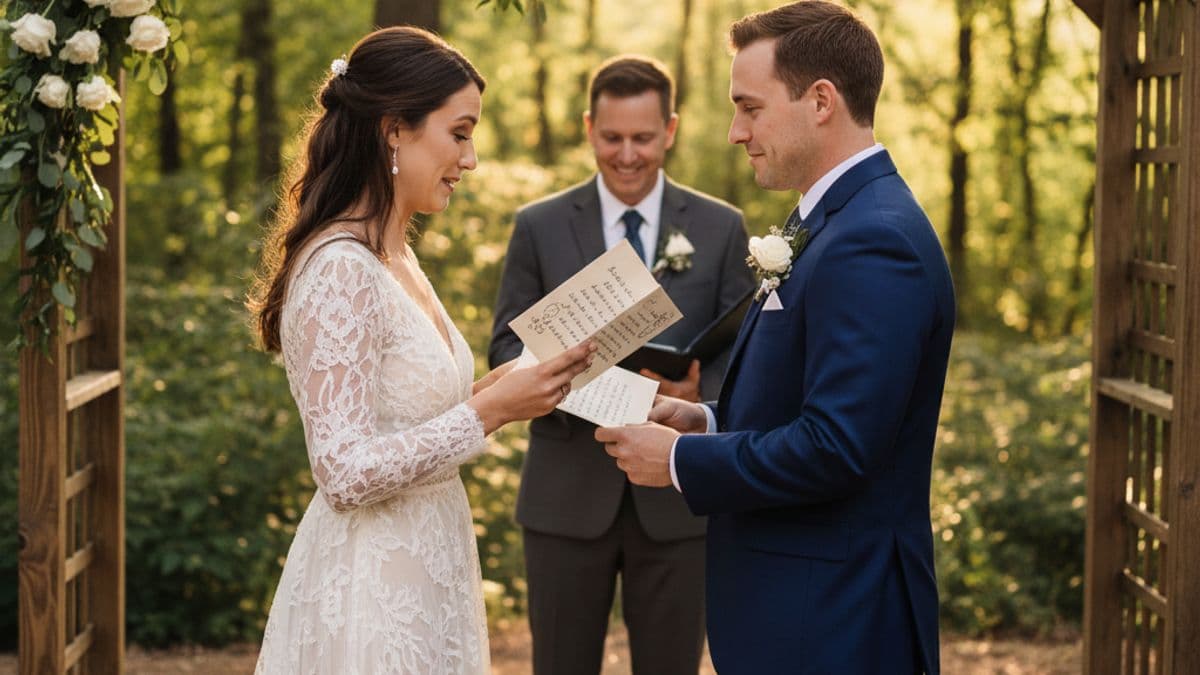
- Print them or write them neatly — Do not read from your phone. A nice card or small notebook looks intentional and elegant.
- Make eye contact — Look at your partner, not your paper. You know the words well enough to look up for the important lines.
- It is okay to cry — If you get emotional, pause, breathe, and continue. The tears make it more real, not less.
- Have a backup — Give a copy to your officiant or best man in case you forget yours.
When Words Are Not Enough
Sometimes the most powerful complement to personal vows is music. If you want to take the emotion of your ceremony to another level, consider pairing your vows with a custom song that tells your love story. A personalized song can be played during the unity ceremony, as an interlude after the vows, or as a surprise for your partner. Our wedding ceremony music timeline shows exactly where each musical moment fits.
Your vows say what you promise. A custom song captures how it feels. Together, they create a ceremony that is entirely, unmistakably yours. Create your personalized wedding song and give your words a melody that will last a lifetime.