Why Music Works for Stress Relief
Stress is not just a mental state — it is a physical one. When you are stressed, your body floods with cortisol, your heart rate increases, your muscles tense, and your breathing becomes shallow. Music addresses stress at both the psychological and physiological level, which is why it works when other methods fall short.
Research has consistently shown that listening to music you find calming can lower cortisol, reduce blood pressure, slow heart rate, and activate the parasympathetic nervous system — the body's "rest and restore" mode. Unlike many stress management techniques that require training or practice, music works immediately and requires nothing from you except pressing play. Our article on the science behind music and mental health explores the research in more detail.
Choosing Music for Relaxation
Not all music is relaxing, and what relaxes one person may agitate another. The most effective relaxation music tends to share certain characteristics, but personal preference always trumps general guidelines:
- Tempo between 60 and 80 BPM — This range approximates a resting heart rate and encourages the body to synchronize
- Minimal lyrics or gentle vocals — Words can engage the analytical mind when the goal is to quiet it
- Predictable structure — Sudden changes in volume or tempo can trigger alertness rather than calm
- Acoustic or ambient textures — Natural instruments and atmospheric sounds tend to be more soothing than electronic or heavily produced music
- Personal resonance — A song that holds positive associations for you will always outperform a technically perfect relaxation track that means nothing to you
Practical Techniques for Music-Based Stress Relief
Listening to music is only the beginning. These techniques use music as an active stress management tool:
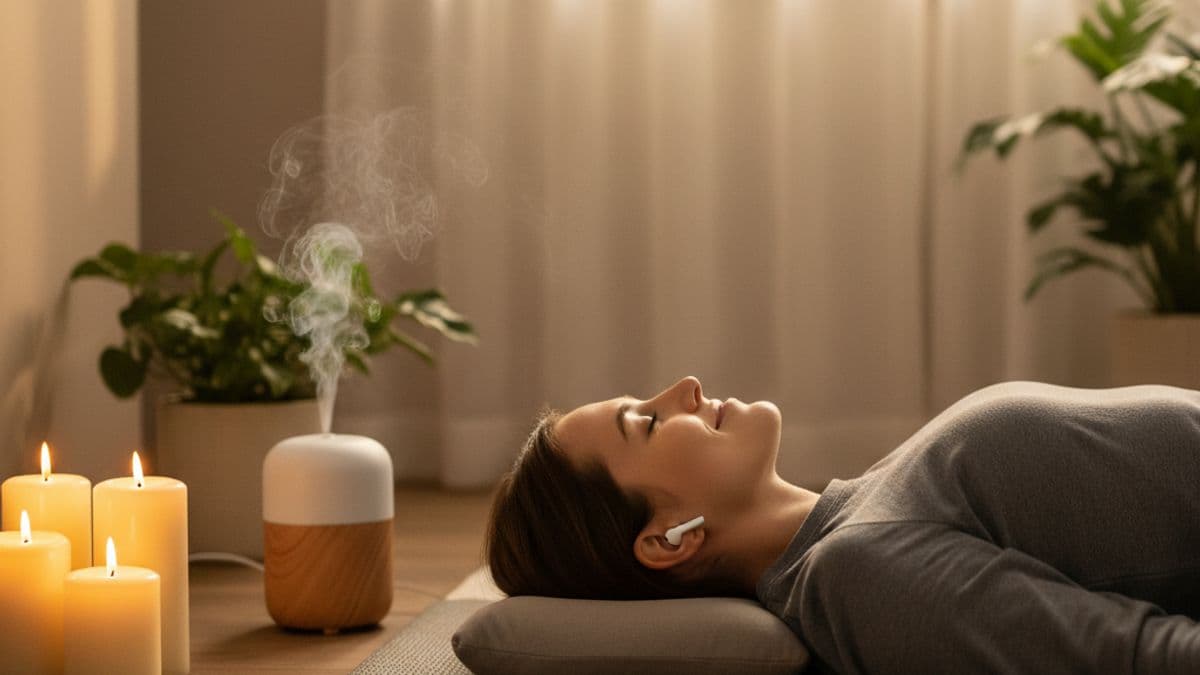
Progressive relaxation with music: Lie down and play calming music. Starting from your toes, consciously relax each muscle group in time with the music, working up through your body. By the time you reach your head, your entire body should be significantly more relaxed.
Breathing synchronization: Choose a slow piece of music and match your breathing to the rhythm. Inhale for four beats, hold for four beats, exhale for four beats. The music provides a natural metronome for your breath.
The transition technique: If you are moving from a high-stress situation to a rest period, create a short playlist that starts with music matching your current energy level and gradually decreases in tempo and intensity. This gradual transition is more effective than jumping straight to slow music, which can feel jarring when you are wound up. Our healing playlist guide walks through building this kind of emotional arc in detail.
Building a Stress Relief Music Routine
Consistency amplifies the effect. When you use the same music for relaxation repeatedly, your brain begins to associate those sounds with calm. Over time, pressing play on your relaxation playlist triggers the relaxation response faster because your brain has learned the pattern. Build a routine around it:
- Morning transition — Play calming music during your first 15 minutes awake instead of reaching for your phone
- Commute decompression — Use your drive or train ride to shift from work mode to home mode with a dedicated playlist
- Pre-sleep wind down — Listen to relaxing music for 20 to 30 minutes before bed. This is one of the most well-supported uses of music for stress.
- Break time reset — Use a five-minute music break during the workday to reset when stress builds
Active Music-Making for Stress Relief
Listening is passive. Making music is active, and the stress relief benefits of active music-making are even stronger in many cases:
- Drumming — Rhythmic percussion has been shown to reduce anxiety and improve mood. You do not need a drum — tapping a table works.
- Singing — Singing engages the vagus nerve, which activates the relaxation response. Sing in the shower, in the car, or wherever you feel comfortable.
- Humming — Even humming has measurable calming effects through vibration and breath regulation
- Playing an instrument — The focused attention required to play music interrupts rumination and worry
Personalized Music for Deeper Relaxation
While generic relaxation playlists are helpful, music that is personally meaningful goes deeper. A personalized healing song created specifically for you can serve as the centerpiece of your stress relief practice. When you commission a custom song, you share what you need — calm, reassurance, encouragement — and the result is a piece of music designed to meet you exactly where you are.
Over time, this personal song becomes your most powerful stress relief anchor. Your brain associates it with calm, comfort, and the knowledge that someone cared enough to create something just for you.
When Music Is Not Enough
Music is a powerful tool, but it is not a cure-all. If your stress levels are consistently high, if you are experiencing panic attacks, or if stress is interfering with daily functioning, music should be one part of a larger approach that includes professional support. Our article on music therapy for anxiety and depression covers clinical approaches. Think of music as the daily maintenance that keeps stress manageable, while therapy and medical care address the deeper roots. Used together, they create a comprehensive approach to well-being.